
About us
Mission & values
We translate reading science and education law into tools families and schools can actually use.
Our mission
Turning research into results for readers
Dyslexia Institute exists to make sure no child's reading future depends on their parents' ability to decode education law or their teacher's access to reading science.
We pursue that mission three ways:
- Advocate. We give parents and educators practical toolkits — letters, scripts, checklists, and legal guides — to secure screening, services, and accommodations.
- Educate. We translate the science of reading and current research into plain language anyone can act on.
- Connect. We help families understand their intervention options and connect with a community of people who've walked this road.

What guides us
Our values
Evidence first
If the research doesn't support it, we don't recommend it. Full stop.
Plain language
Laws and research only help when people can actually understand and use them.
Families & teachers together
Children win when the adults around them advocate as a team, not adversaries.
Strengths, not stigma
Dyslexia is a difference in how the brain processes language — never a measure of a child's potential.
Press & media
Press kit
Covering dyslexia, screening laws, or the science of reading? Everything below is free to use with attribution ("Dyslexia Institute, dyslexia-institute.com"). For interviews, data questions, or comment on state policy, email hello@dyslexia-institute.com.
Boilerplate
Short: Dyslexia Institute is a free advocacy and education resource that turns reading science and education law into exact next steps for parents and educators of children with dyslexia.
Long: Dyslexia Institute (dyslexia-institute.com) provides plain-language explanations of dyslexia, age-by-age warning signs, step-by-step advocacy toolkits, state-by-state legal guides, evidence-based intervention guidance, and cited news analysis. Every claim is sourced, every tool is free, and membership is open to parents, educators, and professionals at no cost.
Fast facts
- Estimates of dyslexia prevalence range from 5% to 17% depending on definition; "1 in 5" is commonly cited (Yale Center for Dyslexia & Creativity).
- All 50 US states now have dyslexia-related laws; implementation, not legislation, is the current gap (our analysis).
- Our printables, toolkits, and legal guides are free for non-commercial educational use with attribution.
Logos & graphics
- Logo, full color (PNG)
- Logo, white (PNG)
- Emblem mark (PNG, 512px)
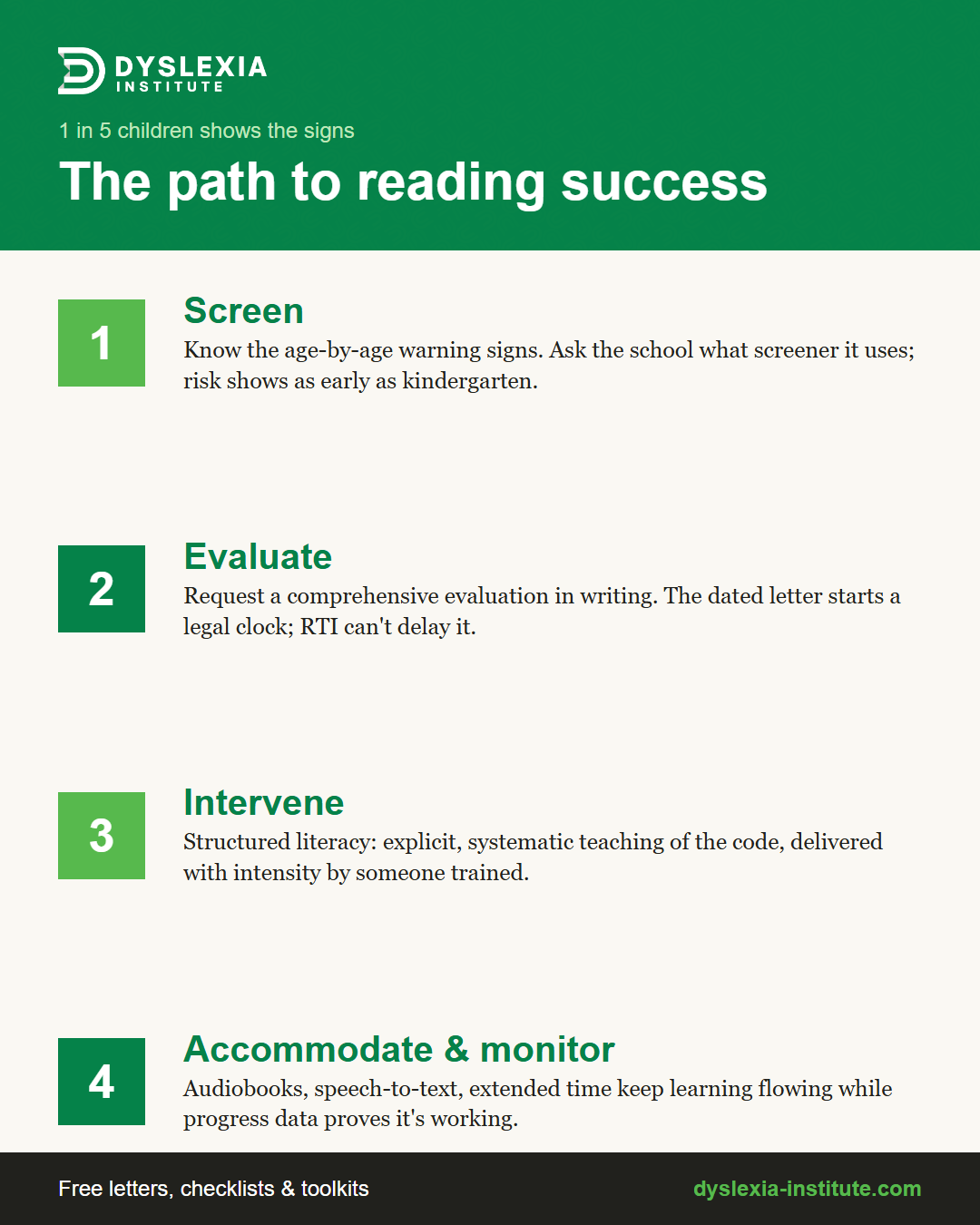
- "Path to Reading Success" infographic (PNG)

Brand colors: green #57b94d, deep green #058249, charcoal #21211d. Please don't alter, recolor, or distort the logo.