
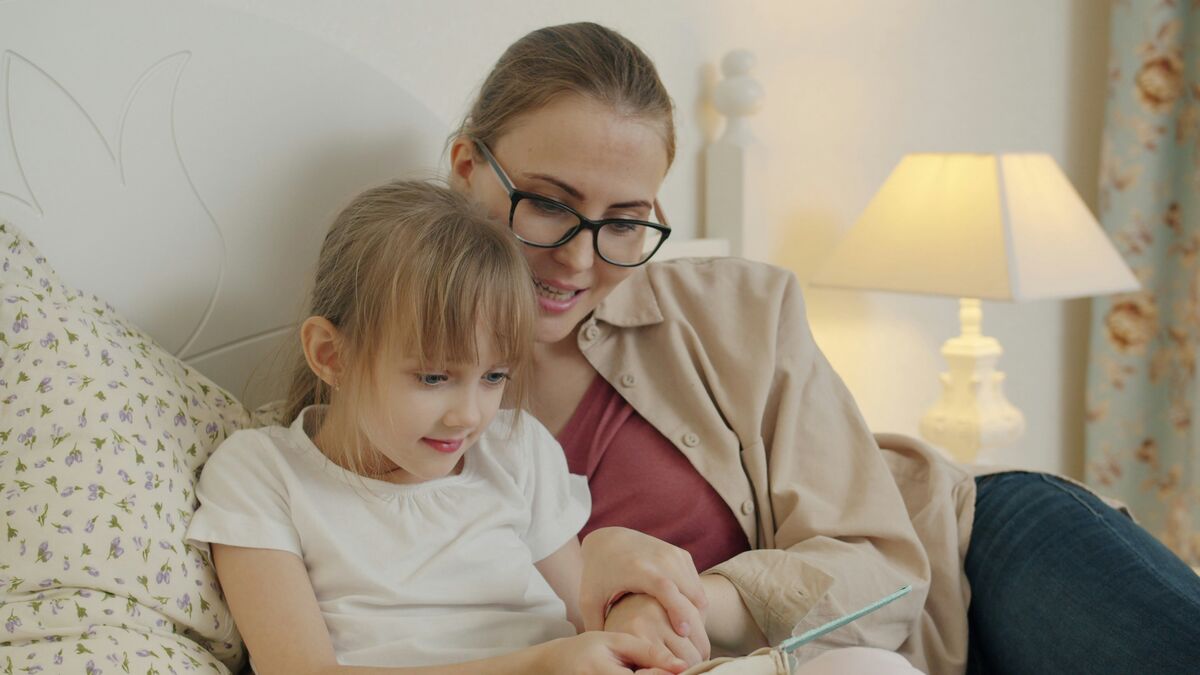
By the time most children are identified with dyslexia, they've spent two or three years watching classmates do easily what they can't do at all — and children don't leave a gap like that unexplained. They write their own story, quietly, and it's almost always some version of I'm dumb. That's why the conversation where a child learns the word dyslexia is bigger than it looks: you're not delivering bad news, you're replacing a corrosive explanation with a true one. The Yale Center for Dyslexia & Creativity, which has counseled families through this talk for decades, reports what clinicians see over and over — children are often relieved to learn there's a name for what's happening, that it's common, and that it isn't stupidity. Here's how to have the conversation well, at any age, without spin in either direction.
When should you tell your child?
Early — as soon as there's something real to name. Parents sometimes delay, hoping to protect a child from a label. But the child already knows reading is hard; the only question is which label they're using in the dark. Secrecy also teaches its own lesson: if we don't talk about it, it must be shameful. Telling a child promptly, in plain terms, models the opposite — this is a thing we understand, discuss, and handle. If an evaluation is underway, narrate that too ("we're figuring out how you learn best"), so the results arrive as an answer rather than a verdict.
What do you actually say?
Three parts, adjusted for age. What it is: dyslexia means your brain handles the sounds inside words differently, so connecting letters to sounds takes more work and more practice — not less brains, more work. What it isn't: it has nothing to do with how smart you are; plenty of brilliant people have it; you didn't cause it and you can't catch it. What the plan is: there's teaching designed exactly for this, you're getting it, and it works. For a six-year-old, that might compress to: "Your brain learns reading in a different way, so we found a teacher who teaches that way. Lots of kids learn like you — about one in five." A twelve-year-old can handle the fuller picture — the brain science, the genetics ("this runs in families; Grandpa had it too"), and the legal rights that come with a diagnosis. At every age, tone carries more than vocabulary: matter-of-fact, unworried, and honest about effort — reading will take you more work than it takes some kids, and the work pays off.
How do you talk about strengths without spin?
Carefully, because children detect inflation instantly. The evidence-honest version: dyslexia makes one specific skill — connecting print to sound — harder; it leaves everything else intact, and your job is to keep the rest of the child's life vivid enough that reading is a thing they're working on, not who they are. Name your child's actual strengths specifically ("you build things I can't figure out"; "you remember every detail of that story I read you"), rather than issuing blanket promises that dyslexia is a gift. Many successful dyslexic adults credit the persistence they built — that's a true encouragement with no false advertising. What you're inoculating against isn't struggle; it's the conclusion that struggle means stupidity.
A script-builder for the first conversation
- Pick a calm moment — not homework, not a meltdown. A car ride works; side-by-side beats face-to-face for hard topics.
- Start from their experience: "You know how reading feels harder for you than it looks for other kids? We found out why, and it's good news."
- Name it and normalize it: "It's called dyslexia. About one in five people have some form of it. It's why you're so good at [real strength] and why words on a page fight back."
- Kill the shame theory directly: "It is not about being smart. You're smart. This is about how your brain hears the sounds in words — and there's a way to teach it."
- Give the plan and a role: "You'll work with someone who teaches reading the way your brain learns it. Your job is to show up and tell us what helps."
- Leave the door open: "You'll have more questions later. Ask me anything, anytime." Then actually revisit it — next week, next year.
What should you avoid saying?
- "Don't worry, it's no big deal." It's a big deal to them. Minimizing teaches them not to bring you the hard parts.
- "Dyslexia is a superpower." A child mid-struggle knows better, and the gap between the slogan and their Tuesday erodes trust. Real strengths, specifically named, work; marketing doesn't.
- Whispering it. If parents lower their voices to say dyslexia, the child learns it's shameful. Say it like you'd say left-handed.
- Making it the whole identity. The goal is a child who has dyslexia and plays goalie and draws dragons — not a walking diagnosis.
How does the conversation grow up with the child?
The first talk plants a seed; self-advocacy is the harvest. Around upper elementary, children can learn to describe their dyslexia and what helps them ("I use audiobooks for long readings; I need extra time on tests"). By middle school they should sit in on part of their IEP meetings; by high school they should speak in them — because at college and work, no parent attends the meeting, and the accommodations only follow the young adult who can ask for them. Along the way, feed the identity good material: stories of dyslexic adults who are visibly thriving, and honest ones — our stories page is built for exactly this. And watch your own language in the house. Children calibrate to how their parents hold the news: if you treat dyslexia as a manageable fact with a plan attached, in time, so will they.
Frequently asked questions
Will telling my child they have dyslexia hurt their confidence? Clinicians consistently report the opposite: children are usually relieved to get a name and an explanation, because the alternative explanation they've built is "I'm stupid." Shame grows in silence. A plain, matter-of-fact conversation replaces it with an accurate story and a plan.
What if my child doesn't want to talk about it? Don't force a summit. Deliver the essentials briefly, leave the door open, and revisit in small moments — a comment during homework, a story about a dyslexic athlete, a question in the car. The message accumulates across dozens of low-pressure touches, not one big talk.
Should we tell siblings, grandparents, and teachers? Yes, with your child's dignity in mind. Siblings need the no-teasing ground rules and the same shame-free framing; grandparents may need myth-correcting (our explainer helps); teachers need the practical version — what helps, what's in the plan. Let your child hear you explain it well; that's the script they'll eventually use themselves.
Source: "Talking with Your Child About Dyslexia" — Yale Center for Dyslexia & Creativity