The science of reading movement has spent five years putting phonics back into classrooms, and for children with dyslexia that work has been overdue. Last week, at The Reading League's 10th annual conference in Chicago, a group of researchers made a complementary point: don't let the focus on decoding crowd out spoken language. Education Week's Sarah Schwartz reported on October 2 that some in the field now call oral language the "sixth pillar" of reading, alongside the five components named by the National Reading Panel in 2000: phonemic awareness, phonics, fluency, vocabulary, and comprehension. For parents and teachers of dyslexic children, this is not a change of direction. It's the other half of the map.
What is oral language, and why call it a pillar?
Oral language is everything a child understands and says out loud: vocabulary, grammar, the ability to follow and tell a story, and the background knowledge carried in words. The idea that reading has two halves is decades old. The Simple View of Reading, published by Philip Gough and William Tunmer in 1986, describes reading comprehension as the product of decoding and language comprehension. If either is near zero, comprehension fails. A child who decodes perfectly but doesn't know what "erosion" means won't understand a science passage. Pamela Snow, a cognitive psychology professor at La Trobe University in Australia, told the conference audience that oral language is "essential to becoming a strong reader and writer," per Education Week. Calling it a pillar is a way of making sure schools plan for it on purpose instead of assuming it happens on its own.
How does oral language connect to dyslexia?
In two ways. First, the core difficulty in dyslexia is usually phonological: trouble noticing and working with the sounds inside spoken words. That's an oral language skill, which is why the best early screeners ask children to rhyme, blend, and split spoken words before they ever see print. Second, many children with dyslexia have strong vocabulary and reasoning, and that strength is one of their best assets. A child who knows lots of words and ideas can use that knowledge to check a shaky decoding attempt ("that can't be 'horse,' the sentence is about a house") and to understand texts read aloud far above their own reading level. Researchers also note that dyslexia and developmental language disorder (DLD), a difficulty with understanding and using spoken language, can occur together. A child who struggles with both needs language support as well as decoding instruction, which is one reason a full evaluation looks at oral language, not only reading.
What did researchers recommend for classrooms?
The practices described at the conference are concrete. Jill Pentimonti, who directs the Early Learning Foundations Lab at the University of Notre Dame, and Sonia Cabell, a professor of reading education at Florida State University, emphasized intentional talk: open-ended questions about content, staying on one topic across several exchanges, and teachers using rich, complex sentences that invite children to answer the same way. One routine highlighted, "Strive for 5," asks adults to extend a conversation to at least five turns. "It takes time for language to grow," Cabell said. Education Week also cited research linking conversational turns to brain development. One widely cited 2018 study in Psychological Science by Rachel Romeo and colleagues found that children who experienced more back-and-forth conversation with adults showed greater activation in a key language region of the brain, independent of the sheer number of words they heard. It's one study, and it shows an association rather than proof of cause, but it fits a long line of findings: talk with a child, not just near them.
How can parents build oral language at home?
- Aim for five turns. Ask, listen, and build on the answer. "What was the best part of recess?" "Tag." "Who was it?" "Me." "How did you get out of it?" Keep going.
- Use the big words. Say "enormous" and "exhausted," then explain them in passing. Children learn vocabulary from hearing words used naturally, again and again.
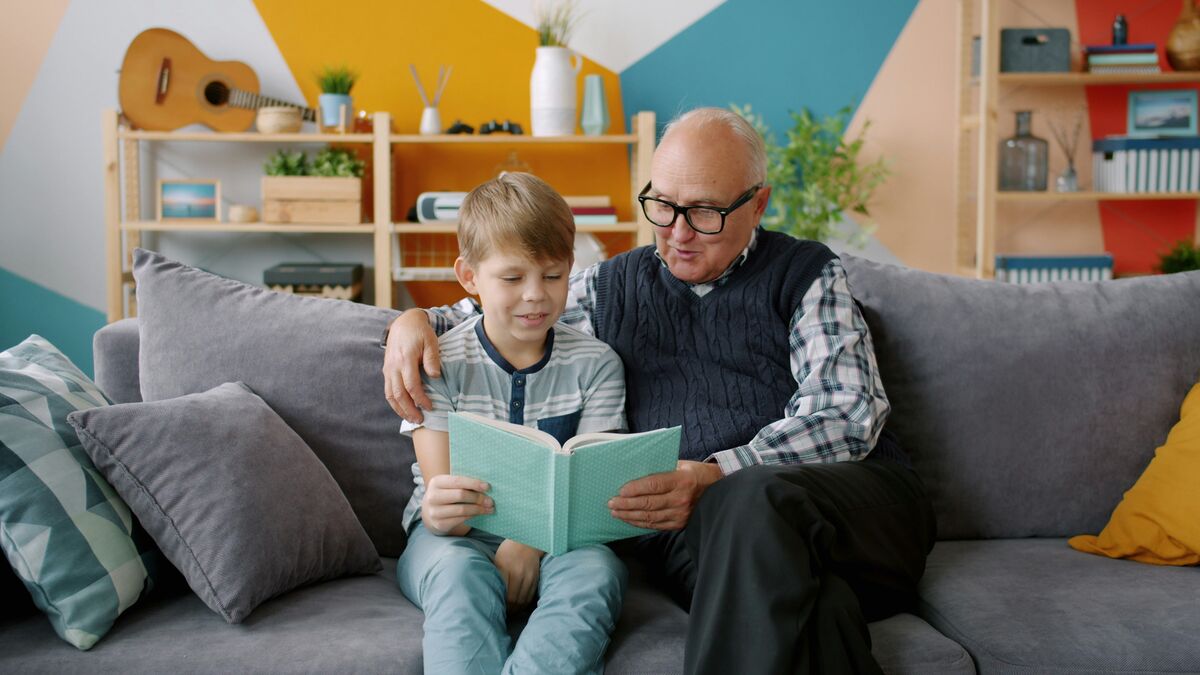
- Read aloud above their level. A dyslexic child's listening comprehension often runs years ahead of their decoding. Feed it. Our case for the daily read-aloud explains why 20 minutes matters.
- Talk about the book. Pause to ask "Why do you think she did that?" or "What would you do?" The conversation is where much of the language learning happens.
- Use audiobooks for access. Listening to books lets a struggling decoder keep growing vocabulary and knowledge with classmates. See our guide to audiobook access.
What should parents and schools avoid?
- Treating it as either-or. Oral language does not replace explicit, systematic phonics for a dyslexic child. Both are needed. Talk alone won't teach a child to decode.
- Quizzing instead of conversing. A string of "What color is that?" questions is short and closed. Real conversation follows the child's interest and goes somewhere.
- Dropping read-alouds once a child can read. For a dyslexic student, books read aloud may be their main source of rich language for years.
- Missing a language difficulty. If your child struggles to follow directions, find words, or tell a simple story in order, mention it when you request an evaluation, and ask that a speech-language pathologist be involved.
Why is this coming up now?
Partly because the science of reading has succeeded. As states rebuild early reading around phonics, researchers want to prevent an overcorrection where classrooms drill decoding and starve comprehension. Schools are also serving more multilingual learners, for whom oral language in English is central (our piece on dyslexia in multilingual children covers how this complicates identification). The House-passed federal bill's definition of the science of reading explicitly includes oral language, as we noted in our coverage of the vote. The message from Chicago fits our long-standing stance: teach the code explicitly, and surround the child with talk and books while you do.
Frequently asked questions
What is the "sixth pillar" of reading? Some reading researchers use the phrase for oral language: vocabulary, grammar, and the ability to understand and use spoken language. It adds to the five components named by the National Reading Panel in 2000. The idea is that schools should plan for spoken language deliberately, alongside phonics and the other components.
Does a child with dyslexia have weak oral language? Not necessarily. Most children with dyslexia have a phonological difficulty with the sounds in words, but many have strong vocabulary and reasoning. Some also have a developmental language disorder. An evaluation should look at both reading and oral language so instruction matches the child's actual profile.
How can I build my child's oral language at home? Have longer conversations, aiming for about five back-and-forth turns on one topic. Use rich vocabulary naturally, read aloud books above your child's reading level, and talk about them. Audiobooks help struggling readers keep growing vocabulary and knowledge while their decoding catches up.
Source: "Don't Overlook the Power of Oral Language, Reading Experts Say" (Education Week, Oct 2, 2026) · "The Reading League to Host 10th Annual Conference in Chicago" (The Reading League) · Gough & Tunmer, "Decoding, Reading, and Reading Disability" (Remedial and Special Education, 1986) · Romeo et al., "Beyond the 30-Million-Word Gap: Children's Conversational Exposure Is Associated With Language-Related Brain Function" (Psychological Science, 2018)